Rank Tracker vs SEMRush: Which SEO Tool is better?
SEMRush is widely regarded as one of the strongest, if not the strongest, SEO software solutions in the industry. With over 10 million registered customers and 400,000 monthly active users, it’s often hailed as the best of the best—that is, before Rank Tracker.
Available at a fraction of the price, Rank Tracker has been getting more and more attention from big-name companies because of its intuitive functions. It’s said to have been used by Commonwealth, Adidas, Red Bull, and even Apple. But is it really better than SEMRush?
In this Rank Tracker vs SEMRush guide, we put that question to rest. We compared the two in a head-to-head battle to see which one is suited for your brand.
What Is Rank Tracker? A Brief Overview
Developed in 2014 by SEO specialist Felix Rose-Collins, Rank Tracker is an all-in-one SEO tool that offers highly specialized SEO rank tracking and content monitoring to help improve your website visibility. It has a clean and beginner-friendly interface, with color-coded tables, graphs, and lists.
Rank Tracker’s primary purpose is to evaluate the rank of a website and list recommendations on how to improve it. It features one of the best in-depth site audits we’ve ever seen, on par with some of the more expensive SEO tools like SEMRush.
Here are some of the most notable features of Rank Tracker:
- A/B testing
- Competitive analysis
- Analytics integration
- Link management
- Keyword research and tracking
- Audit management
- SERP checker and simulator
- Actionable SEO Tasks
Unlike some SEO tools that track rank from only one search engine (read: Google), Rank Tracker tracks website rankings from almost every search engine and location across the globe. It also tracks real-time fluctuations and ranking changes, so you’re always guaranteed up-to-date information.
What Is SEMRush? A Brief Overview
SEMRush is one of the oldest and most popular SEO software solutions in the market. It was developed in 2008 by IT engineers Oleg Shchegolev and Dmitri Melnikov with the hopes of creating an all-in-one SEO marketing tool.
Over the years, SEMRush has garnered over 10 million registered users, most of which are paying customers.
SEMRush is different from other SEO tools because of two main factors: it’s an extremely in-depth analysis and a massive keyword database.
To date, we’ve yet to review a digital marketing tool that offers as much real-time information as SEMRush. As for its database, SEMRush has 20+ billion keywords, 40+ trillion backlinks, 800+ million domains, and 140+ geo databases. In comparison, Rank Tracker only has about 5 billion keywords. Still impressive, but certainly not as jaw-dropping as SEMRush.
SEMRush has the following important features:
- Audit management
- Content marketing
- Competitive analysis
- Keyword research
- On-page SEO
- Local SEO
- Backlink tracking and link building
- Rank tracking
- Video rank tracking
- Social media management
- Google Ads Keywords (including of competitors)
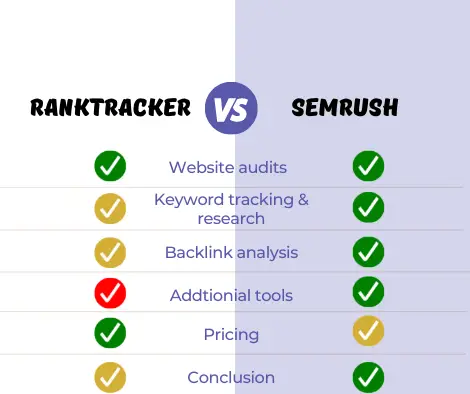
Rank Tracker vs SEMRush: Side-by-Side Comparison
Now that we’ve discussed the basic premise of both tools, let’s take a lot at how they compare with one another:
Site Audit
A site audit is a process in which a website is given a full “health check” to track how well it’s doing in terms of search engine ranking and overall page quality. It helps website owners discover hidden issues that hinder their online visibility and fix the problem according to the recommended solutions given by the SEO tool.
On this front, both SEMRush and Rank Tracker perform wonderfully. They analyze overall site health, missing information (meta descriptions, title tag, image alt attributes, etc.), HTML element usage and page structure, and general ease of navigation. They also check technical SEO issues like broken links and unresponsive or outdated XML sitemaps and robots.txt files.
Like most audit software, SEMRush and Rank Tracker provide you with some improvement measures in the audit report and rank them from the highest priority to the lowest priority.
Keyword Position Tracking
As you might expect from an SEO tool called “Rank Tracker,” there’s little to complain about its website tracking feature. With it, you can get an instant overview of the most important SEO metrics related to page scores.
Rank Tracking regularly updates its information in real-time and monitors any fluctuations that would occur after a certain period of time. It also provides useful ranking details of your keywords, competitors, vital metrics, and other essential aspects. The number of keywords you can track for each given URL differs from package to package, but you’ll generally be able to track up to 100 keywords a day.
SEMRush does much the same, but on a grander scale. Apart from website and search rankings, the SEMRush tracking tool offers geographical location comparisons, project device types, local competitor performance, and others. The given information is updated every 24 to 47 hours, so you’ll get up-to-date results every time.
Keyword Research
When it comes to keyword research, it’s difficult to beat SEMRush’s database of 21+ billion keywords. It’s likely the biggest keyword database in the industry, so it automatically takes the crown with this one. In comparison, Rank Tracking only offers about 7+ billion keywords.
SEMRush’s keyword gap analysis tool helps to quickly uncover your competitor’s targeted keywords. They also make it possible to spy on competitor paid keywords.
Backlink analytics and link building
Both tools have robust backlink tools to uncover the backlinks of any given page, and they help craft a link building strategy and campaign, as well as backlink audits of your own domain. You can monitor the performance of your incoming links.
Rank Tracker vs SEMRush: Pricing and Plans
Price is one of the most decisive factors when choosing between two tools that both offer comprehensive SEO feature sets. Rank Tracker and SEMRush operate in very different price brackets, and understanding what you actually get at each tier matters more than the headline number.
Rank Tracker Pricing
Rank Tracker positions itself as the more accessible option. Its entry-level plan starts at a significantly lower monthly cost than SEMRush, making it an attractive choice for freelancers, solo consultants, and small businesses that need reliable keyword tracking and ranking data without the financial commitment of an enterprise-grade platform. Plans scale based on the number of keywords tracked and the number of websites you manage, which keeps costs predictable as your operations grow.
For those running lean SEO efforts on a tight budget, Rank Tracker delivers a solid core feature set at a price point that is genuinely difficult to argue with.
SEMRush Pricing and What It Offers
SEMRush operates across three main tiers — Pro, Guru, and Business — with pricing that reflects the depth of what the platform provides. Even at the entry Pro level, SEMRush offers access to its full keyword database, site audit tools, position tracking, and competitor analysis features. Moving up to Guru and Business unlocks historical data, extended limits, content marketing tools, and multi-user access.
The higher cost is easy to justify when you consider everything SEMRush offers across its toolset. From Google Ads keyword spying to video rank tracking and social media management, it functions less like a single SEO tool and more like a complete digital marketing suite. For agencies and established businesses managing multiple properties and running complex SEO strategies, the price-to-value ratio remains strong.
Free Trial Options
Both tools offer a way in before you commit financially. Rank Tracker provides a free version with limited functionality, which is useful for getting a feel for its interface and core tracking capabilities. SEMRush offers a free trial on its Pro plan, giving new users temporary access to its full feature set before making a purchase decision. If you are on the fence, the free trial is the most practical way to evaluate whether SEMRush’s depth justifies the monthly investment for your specific needs.
Rank Tracker vs SEMRush: User Experience
Beyond features and pricing, the day-to-day user experience of a tool matters enormously — especially if you are logging in multiple times a week to check keyword performance, run audits, or pull reports for clients.
Rank Tracker Interface and Usability
Rank Tracker has a clean, beginner-friendly layout that makes it easy to navigate from day one. The color-coded dashboards, tables, and graphs reduce the cognitive load of interpreting data, which is particularly valuable for users who are newer to SEO or who prefer a more streamlined workflow. There is little clutter, and most key functions are accessible within a few clicks.
For small teams or solo operators, this simplicity is a genuine advantage. You spend less time figuring out where things are and more time acting on the data.
SEMRush Interface and Learning Curve
SEMRush has a steeper learning curve, there is no getting around it. The sheer volume of tools, reports, and data points available means the interface is naturally more complex. New users often spend their first few sessions getting oriented before they can fully leverage what the platform offers.
That said, once you are familiar with the layout, SEMRush becomes an extremely efficient working environment. The sidebar navigation is logically organized, projects keep your tracked domains neatly separated, and the reporting tools are flexible enough to be adapted to almost any workflow. For experienced SEO professionals, the depth is a feature, not a flaw.
Rank Tracker vs SEMRush: SERP Features and Tracking
Modern search results are no longer a simple list of ten blue links. SERP features — including featured snippets, People Also Ask boxes, local packs, image carousels, and knowledge panels — have fundamentally changed how keyword performance should be interpreted. A keyword ranking in position three but triggering a featured snippet above it tells a very different story than a clean position three result.
How Rank Tracker Handles SERP Features
Rank Tracker includes a SERP checker and simulator that gives you a view of how search results look for any given keyword. It identifies which SERP features are present and tracks whether your pages are appearing in them. For most small to mid-sized SEO campaigns, this level of SERP visibility is more than adequate.
SEMRush SERP Feature Tracking
SEMRush goes further. Its position tracking tool shows not just where your pages rank, but which SERP features are triggered by each keyword and whether you or a competitor currently owns them. This level of detail is particularly useful when building out SEO strategies around high-value terms where a featured snippet or local pack appearance could deliver more traffic than a standard first-page ranking alone.
The ability to identify SERP feature opportunities at scale gives SEMRush a meaningful edge for teams running competitive, data-heavy campaigns.
Rank Tracker vs SEMRush: Competitor Analysis
Understanding what your competitors are doing in search is just as important as optimizing your own site. Both tools approach competitor analysis differently, and the gap between them is more significant than it might first appear.
Competitor Analysis in Rank Tracker
Rank Tracker allows you to monitor how your competitors rank for the same keywords you are targeting. You can track their position movements over time and get a side-by-side comparison of keyword performance across multiple domains. For straightforward competitive tracking, it covers the essentials well.
Competitor Analysis in SEMRush
SEMRush treats competitor analysis as one of its core strengths. The platform allows you to enter any competitor domain and pull a comprehensive breakdown of their organic keyword portfolio, paid search activity, backlink profile, and top-performing content. The keyword gap tool is particularly powerful — it surfaces keywords your competitors rank for that you currently do not, uncovering opportunities that might otherwise go unnoticed.
Beyond organic search, SEMRush lets you analyze competitor Google Ads campaigns including their ad copy, targeted keywords, and estimated spend. For businesses running both organic and paid SEO strategies in parallel, having that dual view inside a single platform is a significant time saver.
How Both Tools Support Your Overall SEO Efforts
Whether you use Rank Tracker, SEMRush, or both, the value of any SEO tool ultimately comes down to how well it supports the actual work — the day-to-day decisions, the client reporting, and the longer-term strategic planning that drives results.
Building a Keyword Tracking and Ranking Workflow
Consistent keyword tracking and ranking monitoring is the backbone of any serious SEO operation. Both tools support this well, though they do it at different levels of granularity. Rank Tracker gives you a clean, focused view of how your target keywords are moving over time. SEMRush layers on additional context — device breakdowns, geographic comparisons, SERP feature ownership, and visibility scores — that makes it easier to diagnose why rankings are shifting, not just confirm that they are.
For agencies managing multiple client accounts, SEMRush’s project structure makes it straightforward to keep each client’s keyword tracking and ranking data siloed and organized without switching between multiple tools or spreadsheets.
Aligning SEO Strategies With the Right Tool
The tool you choose should reflect the complexity of the SEO strategies you are running. If your work centers around a single website with a clearly defined set of target keywords, Rank Tracker’s focused feature set is well matched to that scope. If your strategies involve layered content planning, competitive gap analysis, paid search integration, and regular reporting to stakeholders, SEMRush’s broader capabilities are better suited to carrying that weight.
When to Use Both Tracker and SEMRush Together
Some SEO professionals use both tracker and SEMRush in combination — leveraging Rank Tracker’s clean interface for day-to-day rank monitoring while relying on SEMRush for deeper research, audits, and competitive intelligence. This is a reasonable approach, though it comes with the obvious cost of maintaining two subscriptions. For most users, committing fully to SEMRush and learning its full feature set will deliver more value than splitting workflows across two platforms.
Who Should Choose Which Tool?
The decision comes down to scale, budget, and the complexity of your SEO work.
Rank Tracker is the right choice for freelancers, small business owners, and anyone who needs dependable keyword tracking and ranking data without a large monthly outlay. Its clean interface, lower price point, and focused feature set make it a practical starting point for businesses building their SEO presence from the ground up.
SEMRush is the right choice for established businesses, marketing agencies, and experienced SEO professionals who need a platform that can handle everything from technical audits and keyword research to competitor analysis, content strategy, and paid search intelligence — all in one place. The learning curve and higher cost are real considerations, but for anyone running SEO at any meaningful scale, SEMRush offers a depth of data and a breadth of tooling that Rank Tracker simply cannot match.
Final Verdict
Both Rank Tracker and SEMRush are legitimate tools with real strengths. But after comparing them across pricing, user experience, SERP feature tracking, competitor analysis, keyword performance monitoring, and overall support for long-term SEO strategies, the verdict is clear: SEMRush is the stronger platform.
Rank Tracker earns its place in the market. The pricing is fair, the interface is clean, and for users with limited budgets or straightforward needs, it does exactly what it promises. There is nothing wrong with it.
But SEMRush operates at a different level. The keyword database is larger, the competitor analysis is more thorough, the SERP feature tracking is more granular, and the overall ecosystem — from content marketing tools to Google Ads intelligence — gives it a versatility that Rank Tracker cannot replicate. The free trial alone is worth taking advantage of, because most users who spend a week inside SEMRush rarely look elsewhere afterward.
For small businesses and startups working with tight budgets, Rank Tracker is a sensible entry point. But for anyone serious about their SEO efforts — running campaigns with real competitive pressure, managing multiple clients, or trying to extract every available advantage from search — SEMRush is the tool worth investing in.
The higher price reflects a genuinely superior product. In this case, you get what you pay for.
Next on your Marketing School Curriculum

Sascha is a Lifecycle Marketing Consultant with over 8 years of digital marketing experiences in Silicon Valley, the UK, and Germany.
After leading the demand generation for a 100+ million company, he decided to venture out on himself. He’s now helping clients to attract and convert more leads and customers.
His main focus are SEO, paid media & marketing automation – all with the focus to tie marketing campaigns to revenue.
Sascha has been featured in industry publications.